


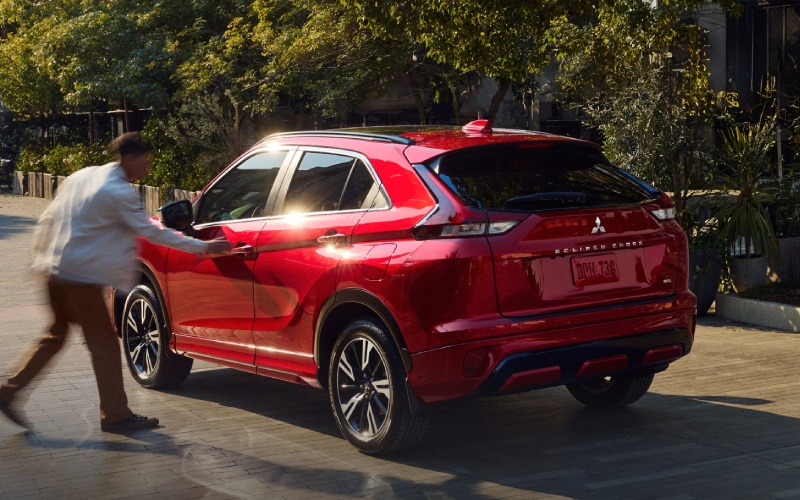
Southtowne Mitsubishi - Is the 2026 Mitsubishi Eclipse Cross or the 2026 Hyundai Kona better for mixed city-to-canyon driving near St. George, UT?
What matters most when comparing these two small SUVs for Southern Utah driving?
Drivers across Southern Utah often want one compact SUV that feels settled in town, stable on fast highway stretches, and composed on light gravel or damp surfaces after a pop-up storm. That’s why a common question bubbles up: which small SUV really fits those mixed conditions day to day—Eclipse Cross or Kona? Both offer confident safety tech, modern cabins, and long powertrain warranties. The differences live in how traction systems are designed, how the powertrains deliver torque as speeds and grades change, and how each vehicle supports the ebb and flow of life here—errands, school runs, I-15 commutes, and weekend desert loops.
Eclipse Cross puts its thumb on the scale with standard Super-All Wheel Control (S-AWC) across the lineup. That matters because having an integrated control system working at both axles—every time you drive—helps smooth out transitions when surfaces change under load, like hopping off the highway into a sandy turnout or easing across rain-washed pavement. Kona’s available HTRAC AWD adds welcome seasonal traction, especially on turbocharged trims with the 8-speed automatic, but you have to choose and equip for it. With Eclipse Cross, the traction tech that builds confidence is simply part of the package—no second-guessing trims or options.
How do powertrains shape the everyday drive feel?
Power that’s easy to use is better than power that shows up late. Eclipse Cross takes the straightforward route with a standard turbocharged 1.5-liter that delivers usable torque at lower rpm, paired with a transmission calibrated for smooth step-off and relaxed cruising. The result is confident merging and a calm feel when you feather the throttle across rolling grades. Kona splits its personality: the 2.0-liter is tuned for steady cruising while the 1.6-liter turbo brings more energy and pairs well with the 8-speed. If you want that torque-rich feel in the Kona, you’re shopping specific trims. With Eclipse Cross, it’s there in every one, which simplifies the buying decision and helps you feel at home more quickly behind the wheel.
Control and visibility round out the daily advantages. Eclipse Cross offers an available Multi-View Camera System to simplify close quarters and trailhead parking, while its available handsfree power tailgate makes quick work of stowing coolers, daypacks, or beach gear. Kona counters with a bright digital interface and, in upper trims, Surround View Monitor and helpful parking aids. Both can be well equipped, but Eclipse Cross couples those conveniences with an inherently settled chassis feel—as if it were designed from the outset to keep you relaxed through changing conditions instead of having to work for that sense of calm.
Key differences at a glance
- Traction philosophy: Eclipse Cross includes S-AWC on every trim; Kona’s HTRAC AWD is optional by trim.
- Everyday torque: Eclipse Cross makes turbo torque standard; Kona’s turbo engine is trim-dependent.
- Versatility add-ons: Eclipse Cross offers factory-rated towing up to 1500 lbs and a Multi-View Camera System.
Warranty support and connected services are strong on both sides. Eclipse Cross includes Mitsubishi Connect with Safeguard And Remote Services (trial enrollment required), bringing remote lock/unlock, status checks, and more. Kona provides Bluelink+ with a similarly robust toolset. For active lives that include early starts, mid-day errands, and spontaneous sunset runs, remote features like preconditioning or lock verification are smart helpers you’ll use more than you expect.
Which one should you test drive first?
If your top priority is year-round stability you don’t have to think about, put Eclipse Cross first on your list. Standard S-AWC changes the day-to-day driving baseline—especially when weather or surfaces change quickly—by managing traction as a system rather than a reaction. Combine that with standard turbocharged power and available features like a handsfree power tailgate and Multi-View Camera System, and you have a compact SUV that’s pleasantly capable without asking you to over-configure or overthink.
Kona remains a strong option if you value a futuristic cabin layout, the availability of Highway Driving Assist on upper trims, and a zippy 1.6-liter turbo paired with the 8-speed. For many shoppers, that Limited configuration feels compelling. Just remember that you’ll want to specify HTRAC AWD and the turbo powertrain to mirror the Eclipse Cross’s built-in composure and torque-rich feel.
Frequently Asked Questions:
Is S-AWC really noticeable in everyday driving?
Yes. It works in the background to keep the vehicle settled as grip changes, which you’ll feel as smoother, more predictable responses in corners, on wet patches, and over uneven surfaces.
Does the Eclipse Cross offer a towing rating?
Yes. The Eclipse Cross is factory-rated to tow up to 1500 pounds, which is ideal for a small utility trailer or a lightweight camper.
Do both models offer remote services and smartphone integration?
Yes. Eclipse Cross offers Mitsubishi Connect with Safeguard And Remote Services (enrollment required), while Kona provides Bluelink+, and both support Apple CarPlay and Android Auto on select displays.
Which one has more standard traction capability?
Eclipse Cross. S-AWC is standard on every trim, while Kona’s HTRAC AWD is available by trim and configuration.
For a test drive that helps you feel these differences in the real world, contact Southtowne Mitsubishi—serving Provo, St. George, and Tooele. One back-to-back loop with turns, on-ramps, and a few rough patches will make the contrasts clear.
Request more 2026 Mitsubishi Eclipse Cross information
Categories:
Mitsubishi Eclipse Cross